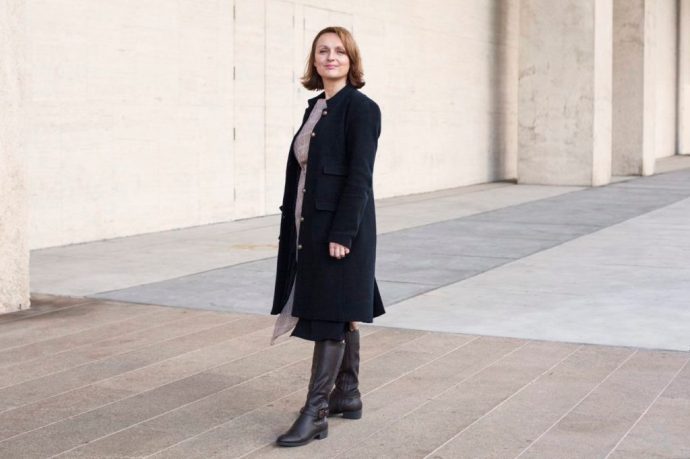
In March 2020 Inga Zhghenti’s translation of Waiting for Godot received critical acclaim as the first Georgian translation of Beckett’s play (from the English text). The translation has been uploaded to the Internet Archive of Georgian Theatre, and is available here. Zhghenti is currently an associate professor at East European University and an invited lecturer at Caucasus University.
Read MorePostponed: Annual Samuel Beckett Society Conference, 2020
Announcement: “In response to the current pandemic, we have postponed our annual conference (Bordeaux) to 2021. Details of future events will be circulated once we have a clearer idea of how things will develop in the next few months.”
Read MoreColloquium to Launch ‘Elements in Beckett Studies’ series in Oxford on March 26 2020
A one-day colloquium in honour of Rosemary Pountney is to be held in Jesus College, Oxford on March 26 to coincide with the launch of the new series ‘Elements in Beckett Studies’ from Cambridge University Press. The speakers, drawn from the series’ authors, will include Anna McMullan , Jonathon Heron and Nicholas Johnson, Olga Beloborodova,…
Read MoreRuby Cohn Travel Bursaries Available
The Samuel Beckett Society and Bordeaux Montaigne University are pleased to announce that we will offer 4 ‘Ruby Cohn Travel Bursaries’ of the value of £300 each to Early Career Researchers wishing to attend the annual conference in Bordeaux in May 2020.
Read MoreBDMP Volume 8: The Making of Samuel Beckett’s Play / Comédie and Film
The latest volume in the Beckett Digital Manuscript Project series, written by Olga Beloborodova, has just been released by Bloomsbury / UPA. It discusses the genesis of Beckett’s short play Play / Comédie and his only film Film. Written around the same time (1962-1963), the two works have self- referential titles that invite meditation on…
Read MoreSamuel Beckett Society Membership Offer
If you join the Samuel Beckett Society with a one-year subscription any time between now and April 2020, you will receive up to three months of free access to the Society’s exclusive content. This offer ends in April 2020.
Read More
The Autumn 2019 Issue of The Beckett Circle Is Now Online
Our new issue of The Beckett Circle is extremely rich. Professor Jim Knowlson talks to the well-known British actor David Neilson about the very different fates of two of Beckett’s most famous manuscripts: Murphy and Waiting for Godot. I had the great pleasure of seeing David Neilson act in Endgame here in Manchester, and the Society is delighted to host this dialogue. The ‘Happy Days: Enniskillen International Beckett Festival’ of 2019 takes centre stage in our issue. In its seventh edition under the guidance of Artistic Director Sean Doran, it has offered a rich programme: in this issue, Feargal Whelan’s interviews Clara Simpson’s bilingual production of Pas Moiand Not I, and Emma Keanie reviews her performance – both will speak to those among us interested in translation not only on the page but also on stage. Brenda O’Connell and Sean Walsh review what sounds like a spectacular interpretation of Come and Go, Catastrophe, and Quad by the Mark Morris Dance Group. I’d like to draw your attention also to Sheila Mannix’s review of How It Is (Part 2) by Gare St Lazare Ireland at The Everyman in Cork.
Read MoreSamuel Beckett and Biopolitics
Estudios Irlandeses.
A new special issue.
Samuel Beckett and Biopolitics.
Edited by Seán Kennedy.
Open access to all.
Read More
The Letters of Samuel Beckett: Location Register
A new online database allows users to track down the location of every known letter, postcard, and correspondence by Samuel Beckett listed in a public archive
Read MoreSex and Gender in Samuel Beckett’s Work
The titles of Samuel Beckett’s two early novels show a taste for salaciousness and provocation that did not disappear in later years, and led to his being expelled from the family home and censored in Ireland. If obscenity became more subdued afterwards, and if sexuality tended to disappear from an increasingly abstract universe, sex, of an often crude kind, is a recurring feature of the Beckettian text. As for sexuality, in its normative version, it is systematically thwarted by the powerlessness and horror of procreation displayed by Beckett’s male characters, whose sexual behaviour “deviates” from the heterosexual paradigm (anality, onanism).
Sex questions the relationship to the other, as a sexual partner and in its gendered dimension. But this relationship is not a straightforward one in Beckett. Before the trilogy, female characters are essentially derealized (either through idealization or belittling, see Mercier, Bryden, Ben-Zvi, McMullan), while male characters are devirilized (Bjørnerud). Moreover, the question of connection and autonomy, central to the fiction and even more to the theatre, is experienced in sexual encounters with particular acuteness. The promise of a union, or even of fusion with the other, stumbles against an impossibility that feeds the melancholy of many characters. Considering that the sexual act is both material and spiritual, it can be traumatic but is also a source of humour and comedy.
Read More