Victoria Myers talks to Judy Hegarty Lovett about her work with Gare St Lazare Ireland
Read More
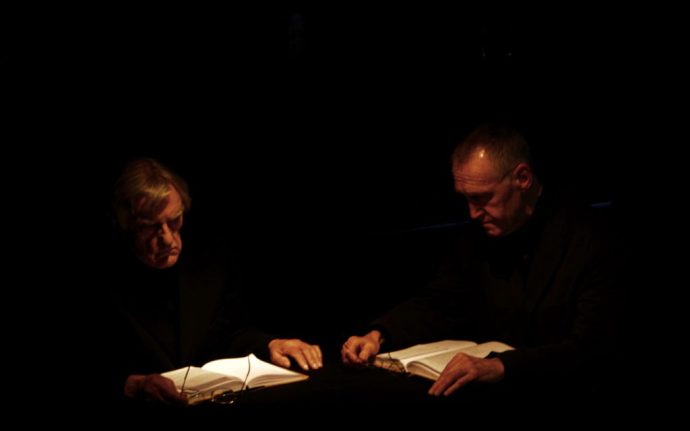
Victoria Myers talks to Judy Hegarty Lovett about her work with Gare St Lazare Ireland
Read More
J. Kelly Nestruck: “Nasmith’s performance is exquisite – the pathos not overplayed, the humour stinging but still funny. When he holds a peeled banana in his mouth, it is the epitome of the word “absurd.” When he listens intently and then gets lost in memory, you see that boat moving gently, up and down, and from side to side.”
Read More
Colette Sheridan: “It is going to be a verbatim performance. But is it very grim? After all, the narrator exists in the mud-dark and ends up in solitude after the other creature disappears. The text has drawn comparisons with Dante’s image of souls gulping mud in the Stygian marsh of the Inferno.”
Read More
Here at the Samuel Beckett Society, we’re not sure what to make of Robert Armstrong’s recent piece in the Financial Times about the end of the male style icon. Armstrong is wistful for a simpler time, when male celebrity figures were supposedly emulated and celebrated for their sartorial choices. What do you think? Does Beckett’s dress code influence the way we think about him as a writer and public figure? Or are these things irrelevant to the books and plays that we love?
Read More
The production will run from 28 February to 17 March 2018. Visit the Battersea Arts Centre website for more information. If you are a member of the Samuel Beckett Society, you can also read a recent review of the Thom production in The Beckett Circle.
Read More
The Irish Examiner: “[Stephen Dillane] is in Cork to rehearse for How It Is, a production of Samuel Beckett’s little-known 1962 novel. It has been adapted by Gare St Lazare Players, the Irish theatre company who have been to the fore in interpreting and performing the writer’s work for almost two decades.”
Read More
Aysegul Savas has written about her experience of knowing the poet Anne Atik as a neighbour. The piece also discusses Anne’s late husband, Avigdor Arikha, and touches on the couple’s friendship with Samuel Beckett
Read More
The Deutsches Literatur Archiv website has posted a series of images from the ongoing ‘German Fever’ exhibition, which explores Samuel Beckett’s enduring connections to German art, culture, and community. Among the images one will find photograph, manuscripts, and correspondence, and will be of great interest to anyone interested in Beckett’s work. There is also an accompanying booklet by the exhibition organisers, Dirk Van Hulle and Mark Nixon.
Read More
Call for Papers: “Mathematics and Modern Literature is a collaborative, interdisciplinary conference exploring the ways in which writers active between the late nineteenth century and the twenty-first century engage with, represent or reflect upon mathematics in their work.”
Read MoreOxford University Press: “[James McNaughton’s] Samuel Beckett and the Politics of Aftermath explores Beckett’s creative responses to the Irish civil war and the crisis of commitment in 1930s Europe, to the rise of fascism, and the atrocities of World War II. Grounded in archival material, the volume reads in Beckett’s letters and German Diaries his personal response to propaganda he saw leading to war, and illustrates his creative work’s intimate engagement with specific political strategies, rhetoric, and events.
Deep into literary form, syntax, and language, Beckett reflects ominous political and historical changes, and satirizes aesthetic and philosophical interpretations that overlook them. He burdens aesthetic production with guilt for how imagination and language, theatre, and narrative parallel political techniques, the aspiration to both effect atrocity and cover it up. This book develops new readings of Beckett’s early and middle work up toThree Novels and Endgame.”
Read More