
Announcement: “In response to the current pandemic, we have postponed our annual conference (Bordeaux) to 2021. Details of future events will be circulated once we have a clearer idea of how things will develop in the next few months.”
Read MoreRuby Cohn Travel Bursaries Available
The Samuel Beckett Society and Bordeaux Montaigne University are pleased to announce that we will offer 4 ‘Ruby Cohn Travel Bursaries’ of the value of £300 each to Early Career Researchers wishing to attend the annual conference in Bordeaux in May 2020.
Read MoreSamuel Beckett Society Membership Offer
If you join the Samuel Beckett Society with a one-year subscription any time between now and April 2020, you will receive up to three months of free access to the Society’s exclusive content. This offer ends in April 2020.
Read More
The Letters of Samuel Beckett: Location Register
A new online database allows users to track down the location of every known letter, postcard, and correspondence by Samuel Beckett listed in a public archive
Read MoreSex and Gender in Samuel Beckett’s Work
The titles of Samuel Beckett’s two early novels show a taste for salaciousness and provocation that did not disappear in later years, and led to his being expelled from the family home and censored in Ireland. If obscenity became more subdued afterwards, and if sexuality tended to disappear from an increasingly abstract universe, sex, of an often crude kind, is a recurring feature of the Beckettian text. As for sexuality, in its normative version, it is systematically thwarted by the powerlessness and horror of procreation displayed by Beckett’s male characters, whose sexual behaviour “deviates” from the heterosexual paradigm (anality, onanism).
Sex questions the relationship to the other, as a sexual partner and in its gendered dimension. But this relationship is not a straightforward one in Beckett. Before the trilogy, female characters are essentially derealized (either through idealization or belittling, see Mercier, Bryden, Ben-Zvi, McMullan), while male characters are devirilized (Bjørnerud). Moreover, the question of connection and autonomy, central to the fiction and even more to the theatre, is experienced in sexual encounters with particular acuteness. The promise of a union, or even of fusion with the other, stumbles against an impossibility that feeds the melancholy of many characters. Considering that the sexual act is both material and spiritual, it can be traumatic but is also a source of humour and comedy.
Read More
Beckett & Italy: Call for Papers for an Academic Conference in Reading
We are delighted to announce a two-conference series on the topic: Beckett & Italy: “old chestnuts”, new occasions. The first conference will take place at the University of Reading from 7-8 November 2019, and the second will take place at “Sapienza” Università di Roma in May 2020. The following is a call for papers for the upcoming conference at the University of Reading…
Read MoreParis Workshop: Beckett, Phenomenology and Ecology, AUP
Phenomenology, from its classical roots in Husserl to its more contemporary intersections with ecology, re-imagines relations between the human and its surroundings. How might phenomenology, then, inspire innovative readings of Beckett’s work around ecological crisis, climate change, and environmental instability? We are envisioning an informal, collegial gathering of scholars of literature and philosophy on 21 June, at The American University of Paris, where we will approach this question from a variety of angles, anchored in reading three Beckett texts and one article on eco-phenomenology. We are eager to bring together scholars thinking with the phenomenological tradition expansively, from Husserl to Merleau-Ponty to Henry, and to include scholars with a variety of approaches to literary texts, from political to comparative to philosophical to psychoanalytic. We are not aiming for the workshop to produce a “product,” but we do hope to explore whether there may be ways for the discussions to continue in future years. We imagine pre-circulating Beckett texts in French and English, with discussion itself taking place primarily in English, and with a couple workshop participants kicking off discussion of each text with informal opening reflections. The workshop is convened by Amanda Dennis and Vincent Lloyd.
Read More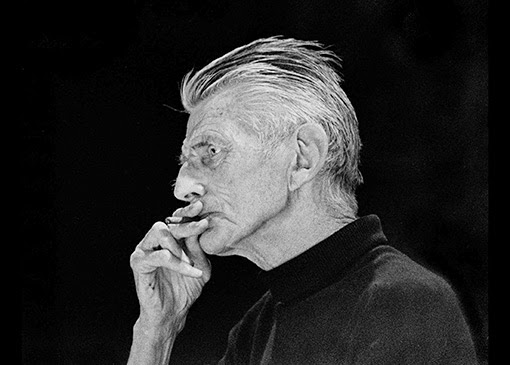
Happy birthday, Samuel Beckett!
“Samuel Beckett came into the world on 13 April 1906. Not only was it an ill-fated Friday the 13th, it was also a Good Friday, the Friday before Easter Sunday, on which the Christian Church commemorates the Crucifixion of Jesus at Calvary. To the superstitiously-minded, any life begun under such ill-fated stars would seem destined for disaster. Throughout his career, Beckett kept thinking back to the unfortunate circumstances of his nativity and the future it seemed to hold. When Judith Schmidt – assistant to American publisher Barney Rosset of Grove Press, New York – wished him many happy returns on 13 April 1962, joking about it being a Friday, he wrote: ‘Very touched by your card and remembrance. I was born on Good Friday 13th, so can’t share your high opinion of the conjunction. And yet when I have the courage to take a quick look back I can see that the miracles haven’t been wanting and that but for them it’s in the better place I’d be for this long time’.” — Dirk Van Hulle and Pim Verhulst
Read MoreCFP: Samuel Beckett and Being Human (MLA 2020)
The Samuel Beckett Society seeks panelists engaging with these three different aspects of the question of ‘being human’ in Beckett: 1) The politics of humanism; 2) The human and technology; and 3) The human and the non-human.
Read More
‘Unique’ Production of All That Fall at this year’s Beckett in Foxrock
The fourth annual festival celebrating the life and work of Samuel Beckett will be held in the author’s home parish church of Tullow in Foxrock, County Dublin, with what promises to be a very atmospheric performance of All That Fall.
Read More The Samuel Beckett Society