Bringing Beckett’s How It Is to the Cork stage

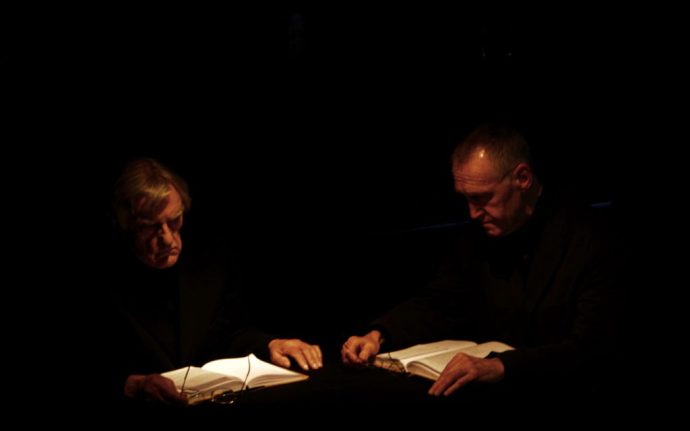
Colette Sheridan: “It is going to be a verbatim performance. But is it very grim? After all, the narrator exists in the mud-dark and ends up in solitude after the other creature disappears. The text has drawn comparisons with Dante’s image of souls gulping mud in the Stygian marsh of the Inferno.”

Read More

Samuel Beckett: Style Icon?

Here at the Samuel Beckett Society, we’re not sure what to make of Robert Armstrong’s recent piece in the Financial Times about the end of the male style icon. Armstrong is wistful for a simpler time, when male celebrity figures were supposedly emulated and celebrated for their sartorial choices. What do you think? Does Beckett’s dress code influence the way we think about him as a writer and public figure? Or are these things irrelevant to the books and plays that we love?

Read More

German Fever: Take a Look at the “Beckett in Germany” Exhibition

The Deutsches Literatur Archiv website has posted a series of images from the ongoing ‘German Fever’ exhibition, which explores Samuel Beckett’s enduring connections to German art, culture, and community. Among the images one will find photograph, manuscripts, and correspondence, and will be of great interest to anyone interested in Beckett’s work. There is also an accompanying booklet by the exhibition organisers, Dirk Van Hulle and Mark Nixon. 

Read More

Mathematics and Modern Literature

Call for Papers: “Mathematics and Modern Literature is a collaborative, interdisciplinary conference exploring the ways in which writers active between the late nineteenth century and the twenty-first century engage with, represent or reflect upon mathematics in their work.”

Read More

Samuel Beckett and the Politics of Aftermath

Oxford University Press: “[James McNaughton’s] Samuel Beckett and the Politics of Aftermath explores Beckett’s creative responses to the Irish civil war and the crisis of commitment in 1930s Europe, to the rise of fascism, and the atrocities of World War II. Grounded in archival material, the volume reads in Beckett’s letters and German Diaries his personal response to propaganda he saw leading to war, and illustrates his creative work’s intimate engagement with specific political strategies, rhetoric, and events.

Deep into literary form, syntax, and language, Beckett reflects ominous political and historical changes, and satirizes aesthetic and philosophical interpretations that overlook them. He burdens aesthetic production with guilt for how imagination and language, theatre, and narrative parallel political techniques, the aspiration to both effect atrocity and cover it up. This book develops new readings of Beckett’s early and middle work up toThree Novels and Endgame.”

Read More

Free Extract: Samuel Beckett and Europe: History, Culture and Tradition

“Cambridge Scholars Publishing is pleased to announce the publication of Samuel Beckett and Europe: History, Culture and Tradition, edited by Michela Bariselli, Niamh M. Bowe and William Davies.

Drawing on the diverse critical debates of the ‘Beckett and Europe’ conference held in Reading, UK, in 2015, this volume brings together a selection of essays to offer an international response to the central question of what ‘Europe’ might mean for our understandings of the work of Samuel Beckett. Ranging from historical and archival work to the close interrogation of language and form, from the influences of various national literary traditions on Beckett’s writing to his influence on the work of other writers and thinkers, this book examines the question of Europe from multiple vantage points so as to reflect the ways in which Beckett’s oeuvre both challenges and enlivens his status as a ‘European writer’.”

Read More