April 13th marks 112 years since the birth of Irish writer, playwright, and Nobel laureate Samuel Beckett. To celebrate, we at the Samuel Beckett Society have assembled a collection of links to celebrate his life, work, and legacy. Enjoy!
Read More
April 13th marks 112 years since the birth of Irish writer, playwright, and Nobel laureate Samuel Beckett. To celebrate, we at the Samuel Beckett Society have assembled a collection of links to celebrate his life, work, and legacy. Enjoy!
Read More
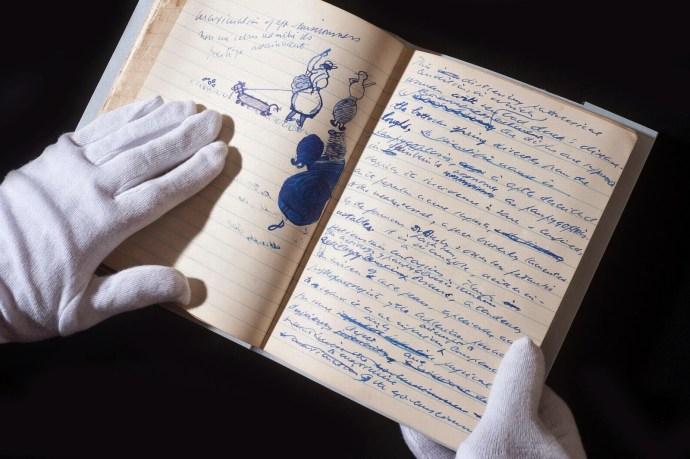
Samuel Beckett first published novel, Murphy, is a comic romp around 1930s London and through the ‘little world’ of the human mind. Beckett weaves together reflections on madness, spirituality, and ginger biscuits with a Swiftian satirical fervour. In a day school at the University of Cambridge’s Institute of Continuing Education, attendees will explore how Beckett’s own life and interests shaped the novel by reading his letters and notebooks alongside the text itself. The course takes place on 21 April 2018, and is hosted by Beckett scholar Andy Wimbush. Visit the University of Cambridge website for more information.
Read MoreVolume 30, Issue 1 of Samuel Beckett Today / Aujourd’hui is a special issue entitled The Poetics of Bilingualism in the Work of Samuel Beckett / La poétique du bilinguisme dans l’œuvre de Samuel Beckett. For more information, visit the publisher’s website.
Read More
In an essay for 3:AM Magazine, Richard Marshall explores the connections between Samuel Beckett and the nineteenth-century German Romantic painter
Read More“On this special episode of The Book Show Eimear McBride (A Girl is a Half Formed Thing, The Lesser Bohemians) visits The Samuel Beckett Collection in University of Reading. There she gains a rare glimpse at the original manuscripts of Beckett’s first publish novel Murphy and his last published prose work Stirrings Still.
With contributions by Head of Archive Services Guy Baxter, Director of the Beckett International Foundation Dr Mark Nixon, Chair of the Samuel Beckett Research Centre Stephen Matthews, Beckett’s biographer and friend James Knowlson, actors Lisa Dawn and Olwen Fouéré.”
Read More
“While Beckett is often seen as impenetrable and difficult, there is so much in this work that is strangely comfortable and familiar. There are many rewards to be found in it if you abandon the compulsion to make sense of it all, and just let it wash over you.
At the end, by whatever strange alchemy is wrought I feel enervated and alive rather than consumed by existential angst. A tale of the unexpected.”
Read More
Originally written in French and first performed at the Royal Court Theatre in 1957, Samuel Beckett’s Endgame is widely regarded as one of his most important works. The Making of Samuel Beckett’s ‘Endgame’/’Fin de partie’ is a comprehensive reference guide to the history of the text.
Read More
First performed in 1953, Waiting for Godot is Samuel Beckett’s masterpiece and one of the most important dramatic works of the 20th century. The Making of Samuel Beckett’s ‘Waiting for Godot’/’En attendant Godot’ is a comprehensive reference guide to the history of the text.
Read More
Beckett, Lacan and the Mathematical Writing of the Real proposes writing as a mathematical and logical operation to build a bridge between Lacanian psychoanalysis and Samuel Beckett’s prose works. Arka Chattopadhyay studies aspects such as the fundamental operational logic of a text, use of mathematical forms like geometry and arithmetic, the human obsession with counting, the moving body as an act of writing and love, and sexuality as a challenge to the limits of what can be written through logic and mathematics. Chattopadhyay reads Beckett’s prose works, including How It Is, Company, Worstward Ho, Malone Dies and Enough to highlight this terminal writing, which halts endless meanings with the material body of the word and gives Beckett a medium to inscribe what cannot be written otherwise.
Read More
“Jess Thom is a founding member of Touretteshero, a theatre company that celebrates the inherent creativity and humour in Tourette’s. She is taking on Samuel Beckett’s Not I, a rapidly delivered monologue spokenby a character called Mouth. Jess explains why the text captures her own experience of living with Tourette’s and her mission to make theatre more accessible.”
Read More