
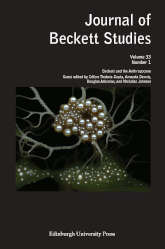
The latest issue of the Journal of Beckett Studies is a special titled Beckett and the Anthropocene. Guest edited by Céline Thobois-Gupta, Amanda Dennis, Douglas Atkinson, and Nicholas Johnson, this volume contains contributions from Laura Salisbury, Einat Adar, Michał Kisiel, Lucas Margarit, Michiko Tsushima, Anna McMullan, Jonathan McAllister, Li Yanshi and Muhammad Saeed Nasir.
As the editorial explains ‘In ‘The Capital of the Ruins’, Beckett describes the ‘provisional’ buildings of the Irish Hospital in St. Lô, built in the aftermath of the Second World War, noting however that the word ‘provisional’ was no longer the ‘term it was, in this universe become provisional’. Today, the universe, or rather our planet, seems particularly provisional, and ‘humanity in ruins’ once again feels like an apt description, a ‘time-honoured conception’. But there is a distinct difference between ‘humanity in ruins’ and a world ruined by humanity. Nevertheless, the ecological crisis, in all its facets, was eerily anticipated by Beckett, who frequently placed his characters, across prose and drama, in what can only be described as environments of catastrophe. Our relationship with other animals on this planet was often examined by Beckett, and he was dismissive of the idea that the Age of Enlightenment had indeed brought understanding and compassion; as Endgame puts it, ‘I say to myself that the earth is extinguished, though I never saw it lit’.
Full details of access and purchase can be made here.

 The Samuel Beckett Society